
.png)

ASEAN Cement Industry Unveils the World's First Regional "2035 AFCM Decarbonization Roadmap"

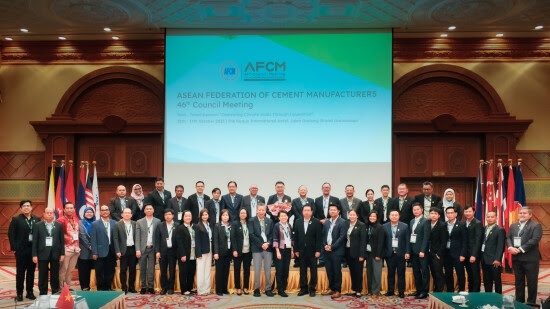
BANGKOK, THAILAND - 1 December 2025 - The ASEAN Federation of Cement Manufacturers (AFCM) has officially launched the 2035 AFCM Decarbonization Roadmap, marking the world's first regional decarbonization strategy for the cement sector.
The announcement was made during the 46th AFCM Council Meeting in Brunei Darussalam, chaired by Dr. Chana Poomee and attended by leaders and representatives from cement associations across all eight AFCM member countries. The launch comes at a pivotal time as global momentum builds ahead of COP30 in Brazil, where climate action will be a central focus.
Cement manufacturing is vital to infrastructure and economic growth across ASEAN, yet it remains a significant source of CO₂ emissions. The 2035 AFCM Decarbonization Roadmap represents a unified regional commitment to accelerate decarbonization in alignment with both national climate policies and global environmental goals, strengthening AFCM's leadership in sustainable cement production.
Dr. Chana Poomee, AFCM President and Chairman of the Thai Cement Manufacturers Association (TCMA), described the 2035 AFCM Decarbonization Roadmap as a major milestone for the region's cement sector. The shared framework will guide systematic CO₂ reduction, enhancing regional competitiveness, and reinforcing AFCM's contribution to global climate solutions.
The 2035 AFCM Decarbonization Roadmap, with strong support from the Global Cement and Concrete Association (GCCA), outlines a comprehensive transition pathway built upon four strategic pillars:
Expansion of low carbon cement enabled by performance-based standards,
Transition to clean and renewable energy across production processes while enhancing efficiency to reduce both thermal and electrical energy consumption,
Deployment of advanced decarbonization technologies, including CCUS, and
Development of new supplementary cementitious materials to support next generation low carbon cement products.
The AFCM President calls on all members to consider the roadmap as a collaborative regional strategy for sustainable progress. At the regional level, these measures have the potential to reduce up to 38 million tons of CO₂ by 2035. While pursuing this collective vision, it acknowledges that the roadmap reflects the diversity of national circumstances, as each member country sets its own decarbonization targets based on regulations, industrial conditions, and available technologies. A key quick win is the reduction and phasedown of Ordinary Portland Cement (OPC), providing an immediate and impactful emissions reduction pathway, reflecting AFCM's determination to accelerate tangible progress.
AFCM member associations from Brunei Darussalam, Cambodia, Indonesia, Malaysia, the Philippines, Singapore, Thailand, and Vietnam expressed support for the regional direction outlined in the 2035 AFCM Decarbonization Roadmap and reaffirmed their commitment to advancing decarbonization in alignment with their respective national contexts. Members acknowledged that while the roadmap sets a collective vision, each country's implementation pathway will vary based on its baseline conditions, energy mix, material availability, policy framework, and market maturity. Members, therefore emphasized the importance of collaboration and supportive policies, increased use of alternative fuels, enhanced energy efficiency, wider adoption of advanced technologies, and the promotion of low carbon cement and concrete, while acknowledging specific targets and pathways may differ across countries.
"The 2035 AFCM Decarbonization Roadmap presents a significant opportunity to enhance regional competitiveness, drive sustainable development, and deliver substantial economic benefits. Government support, including policy adaptation, will be essential to ensure the roadmap's effective implementation. Through collaboration, innovation, and collective action, AFCM can accelerate the adoption of low carbon technologies, attract green investment, create new economic opportunities, and build a resilient, future-ready cement industry that makes a meaningful contribution to global decarbonization," Dr. Chana concluded.
The issuer is solely responsible for the content of this announcement.
Berita Lainnya
CUHK Faculty of Social Science: Fostering Global Excellence in Social Impact and Innovation
Ascott Expands Pet-Friendly Offerings With lyf one-north Singapore
"When We March Together": Youth, Music, and the Future of China-US Relations
DHL Summit Solutions, Inc. (DSSI) accelerates sustainable transport with largest-owned EV fleet in the Philippines
"Swimming Jewels" Nishikigoi - Niigata-bred Koi Wins Top Prize at Global Beauty Competition
2nd GTI Forum on Digital Intelligence Convenes in Hong Kong Forging Global Consensus to Advance Inclusive AI Development
MSIG launches TravelEasy Flex, an affordable travel insurance that can be tailored to policyholder's needs
Ayako Rokkaku Unveils 'THE ISLAND - ONIGASHIMA' at LANDMARK: A Monumental Artistic Odyssey in Central
Live4Well Partners with Cathay to Offer Exciting Rewards - Experience the International Rugby Event
Madame Tussauds Unveils 13 New Taylor Swift Figures in Historic Global Launch
When AI Meets Digital Trade: Hangzhou to Host the Global Digital Intelligence Carnival
A Smoother Ramadan Starts Here: Shopee's Feb 15 Jualan Persediaan Ramadan