
.png)

Beyond the Carbon Blind Spot — Embodied Carbon and Scope 3 Emissions in the Commercial Property Sector on the Chinese Mainland

HONGKONG SAR - Media OutReach Newswire - 22 April 2026 - Cushman & Wakefield, a leading global real estate services firm, today released its annual Beyond the Carbon Blind Spot – Embodied Carbon and Scope 3 Emissions in the Commercial Property Sector on the Chinese Mainland, a landmark report highlighting the growing importance of whole-life carbon in shaping the future of real estate investment, development, and asset performance.
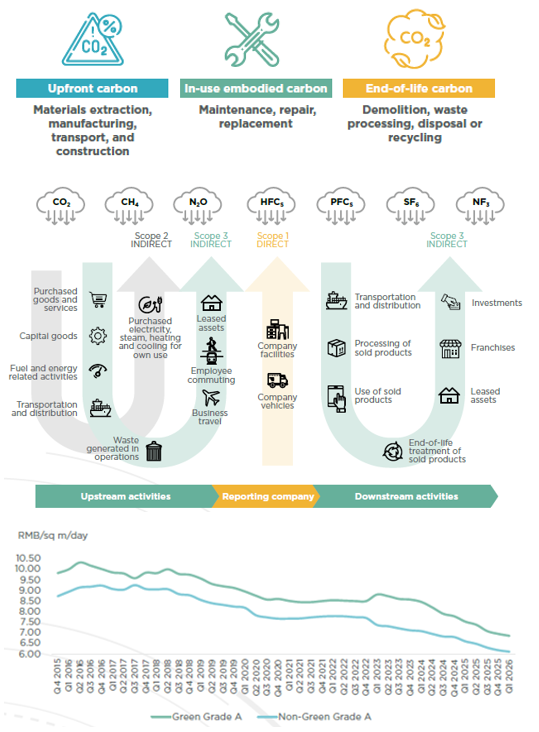
What is Embodied Carbon?Scope 1, 2 and 3 Emissions in Commercial Real EstateShanghai – The Average Green Grade A Office Rental Compared to the Average Non-Green Grade A Office Rental (Q4 2015-Q1 2026)Source: Cushman & Wakefield Research
What is Embodied Carbon?
Scope 1, 2 and 3 Emissions in Commercial Real Estate
Shanghai – The Average Green Grade A Office Rental Compared to the Average Non-Green Grade A Office Rental (Q4 2015-Q1 2026)
Source: Cushman & Wakefield Research
The report finds that while operational energy efficiency has improved significantly across the sector, embodied carbon and Scope 3 emissions now represent the majority of total lifecycle emissions in many commercial buildings.
A Shift to Whole-Life Carbon Thinking
As building efficiency improves and electricity grids decarbonise, the relative importance of embodied carbon is increasing. The report highlights the "redevelopment paradox": while new buildings are more energy efficient, demolition and reconstruction can generate such high upfront carbon that total lifecycle emissions may exceed those of retained and refurbished assets.
This shift is particularly relevant in rapidly evolving urban markets such as Shanghai, Beijing, Shenzhen, and Guangzhou, where redevelopment cycles are frequent and asset repositioning is common.
Scope 3 Becomes a Core Market Driver
Scope 3 emissions – covering embodied carbon, tenant energy use, and supply chain activities – are now the largest emissions category for most real estate portfolios.
The report shows that leased office space is increasingly a key Scope 3 exposure point for occupiers, especially multinational companies operating under global net-zero commitments. As a result, Scope 3 performance is now influencing:
Leasing decisions and tenant demand
Capital allocation and ESG investment screening
Access to green finance
Corporate disclosure and benchmarking frameworks
Carbon as a Financial Factor
Embodied carbon and Scope 3 emissions are no longer just sustainability metrics – they are collectively a financially material driver of asset value. The report demonstrates that differences in whole-life carbon performance can create meaningful divergence in asset outcomes through:
Rental performance and occupancy resilience
Operating costs and capital expenditure requirements
Exit yields and investor demand
A comparative analysis shows that carbon performance alone can drive a value differential of approximately 37% between otherwise identical assets.
From Risk to Opportunity
While regulatory frameworks continue to evolve, global capital and leading occupiers are already embedding whole-life carbon considerations into decision-making. The report highlights a clear opportunity for market participants who act early through:
Adaptive reuse and retrofit-first strategies
Low-carbon materials and construction innovation
Supply chain engagement and procurement reform
Green leasing and tenant collaboration
Improved carbon data and governance frameworks
Beyond the Carbon Blind Spot concludes that the Chinese mainland commercial real estate sector is entering a decisive new phase where whole-life carbon performance is becoming central to competitiveness, asset value, and investment strategy. Stakeholders who integrate embodied carbon and Scope 3 considerations into core decision-making today will be best positioned to enhance resilience, unlock capital, and deliver long-term value in a rapidly evolving market.
Alton Wong, Executive Director, Head of Sustainability Advisory Services, Head of Advisory Services, Valuation and Advisory Services, Greater China, said, “Embodied carbon and Scope 3 emissions are now firmly at the centre of the decarbonisation agenda for commercial real estate. As operational performance improves, the industry is being forced to confront the much larger, and more complex, emissions embedded across the full asset lifecycle. This is driving a fundamental shift in how buildings are designed, constructed and managed, with increasing emphasis on material choices, retrofit strategies, and supply chain engagement. What was once considered a technical sustainability issue is now a core strategic priority for investors and occupiers alike.”
Shaun Brodie, Head of Research Content, Greater China, said, “Our research shows that carbon is rapidly becoming a defining factor in commercial real estate performance on the Chinese mainland. The transition to whole-life carbon thinking is not just about reducing emissions – it is about understanding how sustainability directly impacts asset value, leasing dynamics, and investment outcomes. As occupiers and capital providers place greater weight on embodied carbon and Scope 3 emissions, assets that fail to adapt risk accelerated obsolescence, while those that lead on carbon performance stand to capture a clear competitive advantage.”
Please click here to download the full report
Hashtag: #Cushman&Wa
Beyond the Carbon Blind Spot — Embodied Carbon and Scope 3 Emissions in the Commercial Property Sector on the Chinese Mainland
Berita Lainnya
HUAWEI SOUND ULTIMATE Series: Defining a New Era of Smart In-Car Audio
Liangshan, China: 300,000 People Celebrate a Torch Carnival Night
Jollibee Continues Stellar Growth Across Southeast Asia, Strengthens Leadership in Key Markets
Alibaba Cloud Accelerates Worldwide AI Innovation and Adoption Across Industries
Experiencing an Authentic Chinese New Year in Chinese Gardens Around the World
Sahm Capital Joins the Arab Federation of Capital Markets (AFCM)
Sun Life celebrates 14 wins at Bloomberg Businessweek Financial Institutions Awards 2025
NHG Health and ST Engineering Team Up to Advance Healthcare with Patient-centred Engineering Solutions and Innovations
Lee Kum Kee Sauce Strongly Supports Consumer Goods Forum China Day 2026
Rhenus to Invest $20 Million USD to Drive Business Growth in Philippines with Strategic Expansion in Infrastructure and Services
XTransfer Joins in 2025 Conference on the Bund
NBA and The Coca-Cola Company Announce Multiyear Global Partnership